How I work
Every few years I write down how I work and hand it to the people I work with, because the alternative is letting them find out by trial and error over six months. This is that document, with the phone numbers taken out.
It is not a list of rules. It is a map. If you work with me and something in here does not match what you actually experience, tell me. That gap is useful information for both of us.
About me
I am American. My father is English, my mother is Swiss, English and Ugandan, and both are American now. That mix has meant a working life spent mostly somewhere else: Georgia Tech, then a research internship with the Arrows Formula 1 team in Oxford, patent work in Vancouver, sales in Orlando, Philips LED in Eindhoven and then Montreal, and an MBA at Rotterdam School of Management. In 2011 I co-founded Hugecity in Atlanta, a way of knowing what was actually happening around you. We sold it to Time Out in 2014 and I was their VP of Product until we went public in 2016. After that I was a tech lead on a congressional campaign, then business lead at a mobility software company we sold in 2019. Now I run enterprise restaurants across Deliveroo and Wolt in EMEA.
I live in Europe with my wife and our two children. My grandmother, aunts, uncles and cousins are all in England, which makes London feel less like a posting and more like a home I have never lived in.
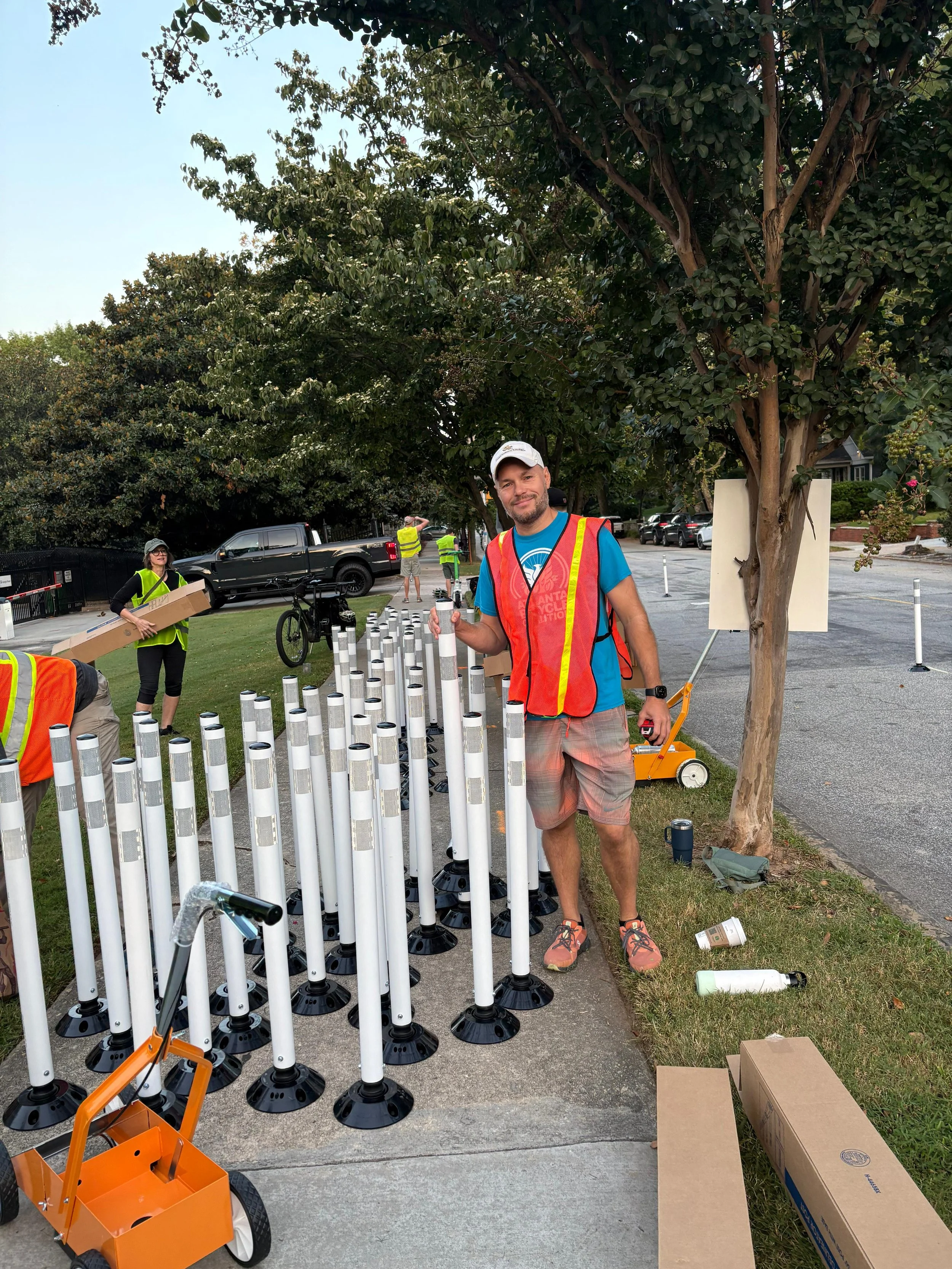
Outside work I swim, bike and run, and I have spent an unreasonable amount of volunteer time on street safety, accessibility and public pools: protected bike lanes to schools, a pedestrian crossing built out of a thousand dollars of Home Depot paint, a community pool that ultimately lost to on-street parking. I mention it because it is the clearest evidence of how I operate. Pick something concrete, build the smallest version that proves the point, and keep coming back at it from different angles.
I am dyslexic. In practice that means you will often find me with my headphones in, listening to something rather than reading it, either a document someone has written or one of the many podcasts I have going. It is almost never music. If you want to talk, I will always stop, unless I am on a call.
How I think
Front-load everything. My management style is heavily front-loaded, and I learned it running a startup. I had developers working at 2am. When they hit a decision, I was asleep. They had to make the best guess themselves, and a wrong guess was expensive. So I got into the habit of painting as much of the picture as I possibly could before work started: the vision, the constraints, why it matters, what winning looks like. Not because I want to specify the answer, but because context is what makes an independent guess a good one.
I like to be managed the same way. If you give me the why, you will very rarely need to give me the what.
Size the risk by the hole it leaves, not by the size of the problem. Doug Curling, my mentor for seventeen years and the retired President and COO of ChoicePoint, put it to me like this: it is not the size of the problem, it is the size of the hole that gets created if the problem blows up. Those are different things, and confusing them is the most common prioritisation error I see. A small problem in a big account can leave a hole you cannot fill. A big, ugly, visible problem sometimes leaves nothing behind at all. Prioritisation is most of my job, and this is the test I use.
What we do is decided by what we choose not to do. Also Doug's, and the line I quote most often. A great deal of no is really just: do I even care about this? I would rather do four things properly than twelve things adequately, and I would rather say no early and clearly than let something die quietly of neglect. If you bring me a list, expect me to ask what is coming off it.
Author and editor. I am a much better editor than author. The most productive relationship I have with the people who work for me is one where they write and I edit. You own the draft, the thinking and the recommendation, and I make it sharper. This means a rough draft is genuinely more useful to me than a finished one, because by the time it is finished my edits cost you something. Send me the 30%.
Two ears, one mouth. I try never to be the only person from our side in a meeting that matters. Partly because I want a check on what actually happened rather than what I think happened, and partly because listening is the part of these meetings that pays. If I have brought you along, you are there to hear it and watch how it lands. You do not need to speak. And if I join one of your meetings, I will try not to speak. It helps me understand where the group actually is, and where I can move it forward.
Several unrelated things at once. I do my best work when I am running very different projects in parallel. It has been described to me as high-functioning ADD and that is probably fair. It means I context-switch easily and I connect things across accounts and regions that otherwise stay separate. It also means my attention can look scattered from the outside when it is not. If you need me deep on one thing, say so and I will go deep on one thing.
I write to think. When a problem is genuinely complicated I write my way through it, and I publish some of it here. This is why I ask for documents rather than conversations. Not as a process tax, but because writing is where I find out whether I actually understand something.
What I value
A 1-pager, almost always. For any real issue I will ask for one. Clean TLDR at the top, the people involved, and the question, the recommendation or the next steps. A dollar value wherever possible.
Not long Slack messages. If it needs three paragraphs, it needs a doc. Point me at the doc.
Substance over polish. Clear thinking in an ugly document beats a beautiful document with weak logic. I will never comment on your formatting.
Real ownership. If I make all the decisions, nobody owns anything, and the work gets exactly the effort that compliance deserves. When people genuinely own something they spend more time on it, get more curious about it, and enjoy it more, and the output is better. That is the trade I am making, knowingly.
Transparency, and bringing people along. Give people a seat at the table early. There is a story about Michelangelo's David. The statue was finished, a critic said the nose was too big, so Michelangelo climbed the scaffold with a handful of marble dust and pretended to chisel while letting the powder fall. The critic watched the dust, decided the nose was fixed, and spent the rest of his life promoting the statue. Ownership is cheap to give away and it turns blockers into advocates.
Grit. Especially when a partner walks away from a product. Trying the same thing again over time, from different angles, eventually finds the combination of the right message and the right stakeholder. Very little is a permanent no. Most of it is a no from this person, in this quarter, framed this way.
What I don't have patience for
Long Slack messages.
No 1-pager.
Hiding a risk.
Waiting for permission.
A problem brought to me without being sized and without a recommendation.
What I expect
I am looking for five things, and they compound:
Go to the lowest level of detail. Play in the data until you can pull a story out of it. Do not wait for an analyst. Know enough SQL to answer your own question, and truth-seek even when the answer is inconvenient.
Then have the presence to tell it. The story is worth nothing if it falls apart under questioning in front of an exec or a partner. Own the room, take the hard question, know where your numbers came from.
Curiosity to keep pulling the thread. When something looks wrong, or just interesting, follow it. Most of what we know about our biggest accounts started as someone refusing to let an odd number go.
Have an opinion, and be able to defend it simply. I used to hire developers building on technology I knew nothing about, and the test was never whether I understood the tools. It was whether they could explain, simply, why they chose one hard approach over another. That told me more about how good they were than anything else.
Grit to hold on after everyone else has left. See above. This is the one I weight most heavily and it is the hardest to interview for.
Alongside that, one standard specific to this kind of work. We partner with QSR brands that are genuinely excellent at food, marketing, real estate and operations, running enormous systems on very thin margins. Our job is to fit our system to theirs, which is a great deal of work and takes real empathy. Delivery is usually the newest channel in a business built over decades, it is often run by a small team carrying more commercial weight than their headcount suggests, and the final call rarely sits with them alone. So the job is to make the case easy to carry: show concretely where the growth is, and build material simple enough that it can be sold internally, and to franchisees, without us in the room. Simple is not a nice-to-have here. It is the whole job.
What I will do for you
I believe in servant leadership, which in practice means my job is to clear the way so you can do yours. Concretely:
Context, not instructions. You will get the why, the constraints and the picture as I understand it, as early as I have it. If you feel like you are guessing, that is a failure on my side and I want to hear about it.
Room to fail. Managing this way genuinely does expose you to failure. I think that is where development happens, and that a team that has been allowed to fail is stronger. What I will not do is let you fail somewhere the hole is too big to fill. That is the judgement I am making when I step in, and I will tell you when I am making it.
Editing, not authoring. Bring me the 30% draft and I will make it better. I will not take it off you.
Unblocking. Removing dysfunction so other people can do their job is, as far as I am concerned, the actual description of my role. Tell me what is in the way.
Friday afternoons back. I block out 3pm on Friday for everyone on my team, so we are not spending the last hours of the week in meetings.
Fast answers. Doug answered everything I ever sent him, usually within hours, for seventeen years, and it is the single most valuable thing anyone has ever done for my career. I will not always match it, but that is the standard I am aiming at. Ask me. Being asked is not a burden.
What I am working on
I front-load so hard it can overwhelm. The same instinct that gives you context can bury you in it. If I have given you forty minutes of picture and you needed one decision, stop me.
Autonomy can read as absence. I leave people alone on purpose. Some people experience that as trust and some experience it as being abandoned, and I am not always good at telling which one you are. Tell me if you want more of me.
Parallel projects look like drift. Working several unrelated things at once suits me and can make my priorities look unstable to everyone else. Ask me to rank them out loud.
I would rather edit than start. Being a better editor than author means I occasionally wait for a draft when I should have written the first version myself. Push the pen back at me when that happens.
I talk slowly. I always have. It means I am often still forming the thought while you are waiting, and in fast rooms I can be talked over. It is not disengagement, and it is not indecision.
I am optimistic about second attempts. The same grit that eventually gets a product landed also means I sometimes keep going at something that genuinely is dead. If you think I am flogging a corpse, say so plainly.
Day to day
I get the kids to school and work out before 9am, and I keep the first hour after that for planning. I try to protect 6 to 8pm for my family. Slack is for short and urgent; long explanations belong in a doc. I check email regularly but slower than Slack, and I save large email blasts for celebrating big accomplishments. I would always rather have a pre-read and a short meeting than no pre-read and a long one.
Why I do this
We need great ideas to move humanity forward, and almost none of them arrive as a single flash of insight. Steven Johnson makes this case better than I can in Where Good Ideas Come From: most important ideas sit dormant for years in a partial form, and they only become useful when they collide with somebody else's half-formed idea. His conclusion is that chance favours the connected mind.
I have spent my career building systems that make those collisions happen faster. Hugecity gave people reasons to leave the house and meet in person. At Citilabs we bought movement data so cities could build for walking, cycling and transit rather than only for cars, and what I learned there is that infrastructure itself is too slow and too expensive to be the lever. You cannot wait for a city to be rebuilt. You can change how the city that already exists gets used. On-demand delivery is now one of the largest single users of the last mile in cities and suburbs, and it sits on top of the shift to digital ordering. Both are changing quickly and neither is slowing down.
Enterprise restaurants are where that gets decided. They lead the conversion of first-time users and the resurrection of dormant ones, and a single account can hold a meaningful share of a market, so how you treat your partners compounds. It also means unusual exposure: to your own executives, to cross-functional teams who need you, and to very large external industries that are sometimes functioning brilliantly and sometimes not at all. You see things first, and in depth, and then you have to choose what to spend time on. That choice is the interesting part.
Work is not everything, so let us have fun with it. Share your side projects. I will share mine.
And one last thing from Doug. In seventeen years I never once understood that being asked was the part he valued. I thought I was taking. So ask me. Early, badly formed, at the wrong time of day. That is not the price of working with me. It is the point of it.