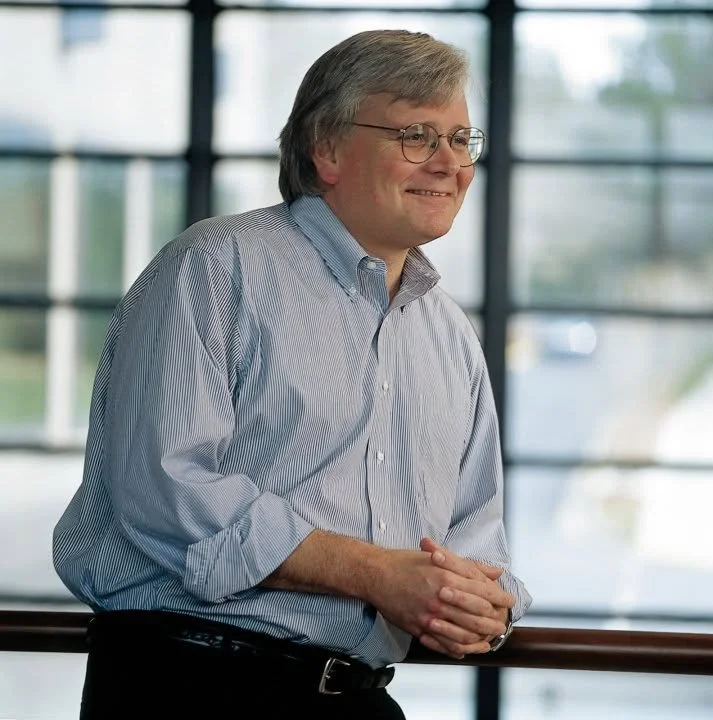
Recorded 9 November 2009. Thirty six minutes on the phone.
In November 2009 I was three weeks from finishing an MBA at Rotterdam School of Management, with a paper to write about how leaders make decisions. I asked Doug Curling, who had stepped down as President and COO of ChoicePoint about a year earlier, for forty five minutes on the phone. He replied in under four hours with three windows to choose from, and gave me thirty six minutes on the Monday afternoon.
My questions are bad. His answers are not. He never names the company on the tape. He just says my company. He swears throughout, which is accurate.
The day after the call I asked whether I could share the recording. He wrote back: "Glad to help -- sure you can share the interview. All my best. Finish strong. DC" Which is almost exactly how the recording itself ends.
The eleven I keep coming back to
These are the parts of the tape I have actually used. The full chapter guide is below.
1. Letting go, and how to size a risk (2:47)
"It's not really the size of the problem, it's the size of a hole that gets created if the problem blows up. And they're different."
I use this constantly in prioritisation, which is most of my job. The question is never how big the thing is. It is how big the hole is if it goes wrong.
2. Trust runs on two curves (5:11)
"There's a curve of, I don't have a lot of experience with you, but as we build more experience and I see you're able to do what we want you to do, then you get more trust. The second is how well we're executing against the agreed upon plan."
3. Knowing what you are not good at (8:15)
"It may not have anything to do with your competitors or the market. It may simply be, we're not wired well for X."
4. Gut instinct is about cohesion, not correctness (12:29)
"I don't think it has as much to do with, is it the right or wrong decision. I think it has more to do with, where do we really need to spend more time on the analysis, and how cohesive is my group going to feel about this decision."
5. How to develop judgment. It is all about knowledge (13:05)
Two instructions. Go into a position where you can observe a lot of the business even if you don't run any of it, what he calls a job that has a point of vision. Then learn what the company has already failed at. At 13:58:
"If you're not aware that they've tried what you're proposing four times and it blew up every time, you don't see any evidence of it as you look forward out the front of the car. You only see it if you look backwards."
6. What you choose not to do (16:12)
"What you end up doing is a function of what you choose not to do, more than a function of what you choose to do."
And at 17:13, what saying no actually is: "A lot of no is, do I even care about it?"
7. What to work on (18:04)
"You're going to go work on the projects that are important to your boss's boss. You're going to go work on the projects that you think are going to lead you where you really want to end up as a leader. Or you're going to go try and work on projects with people that you think can help make you a better manager."
8. Doubling your discretionary time (18:39)
The way you expand your discretionary time is to work more hours. Then, at 20:09, what those hours actually buy you:
"You see their fingerprints as evidence on a lot of different topics. You also see them, they go to all the speeches that are offered by the management team, they go to all the town halls, they have questions. So you just see them engaged, and that engagement is coming out of their discretionary hours."
That is how you become known. At 20:50 comes the reward: "Normally those people are offered more challenging assignments, and if they do well at that, then yes, they will move up quicker." And seven seconds later, the catch: "By being visible they don't move up quicker, because a dummy is a dummy is a dummy."
9. Knowing when to defer (23:49)
"If you're not the smartest guy in the room, you've got to know when you should rely on others."
10. Put the other kind of person in the room (30:59)
"My boss was very creative. I was more of an implementer. He was kind of the architect, I was kind of the carpenter."
He brought creative people into his meetings, and got brought into theirs, so that somebody was always checking whether the plan would survive contact with reality.
11. The long game (31:54)
"It's hard to succeed in a long business career and not do the right thing."
Where to find things
1:15 Letting go, and what it actually costs
"As you elevate yourself in an organization, you typically become less involved in making decisions about what's going on, and you become more prominently involved in eliminating dysfunction so that other people can do their job." (1:40)
Then the test he used for when to step in, which is not the obvious one. At 2:47: "It's not really the size of the problem, it's the size of the hole that gets created if the problem blows up. And they're different."
3:20 Capability versus credibility
"You're going to think you have a lot of capability, and you probably do, but you have very little credibility, because you don't have a demonstrated track record. And both of those are needed to be successful." (3:37)
From 4:20, how he actually supervised people: agree a plan, then leave them alone. An adult manager in a sophisticated organization wants to be left alone, and does not want to be burdened with undue supervision. At 5:30, cheerfully, hiring from outside is a crapshoot no matter whose resume it is.
7:40 Internal and external patterns
The most self aware ninety seconds on the tape, and the line that explains what he did for a living.
"My company wasn't great at de novo startup ideas. We were much better at taking something somebody got going and then commercializing it." (8:21)
At 9:15 he explains why his company deliberately used a different hurdle rate than everybody else, because they knew from experience that they always overestimated revenue and underestimated cost and time.
10:40 Gut instinct is not gut instinct
"The truth is, that really isn't gut instinct. It's really their experience and their knowledge helping them make a decision quicker than anybody else. They're already processing the patterns. They just do it subconsciously rather than consciously." (11:01)
He then makes it useful in two ways: as an early warning about your own bias, and as a read on whether your group will be cohesive.
12:50 How you actually learn this
At 13:05, go in to what he calls a job that has a point of vision. A seat where you can see how the whole thing works, even if you don't run any of it.
And the part worth playing twice, at 13:58: "If you're not aware that they've tried what you're proposing four times and it blew up every time, you don't see any evidence of it as you look forward out the front of the car. You only see it if you look backwards."
At 14:15, his method for finding out. Take people out for beers.
14:40 Saying no
"What you end up doing is a function of what you choose not to do, more than a function of what you choose to do." (16:12)
The line I quote most.
17:45 Discretionary time, and who gets noticed
At 18:39, the way you expand your discretionary time is to work more hours. Blunt, and he means it kindly. The extra hours are an investment in understanding, not in being seen.
Then, so nobody mistakes visibility for merit, at 20:57: "By being visible they don't move up quicker, because a dummy is a dummy is a dummy. You don't empower dummies."
22:00 When not to use your own judgment
"I hire people, I hire adults, I should treat them like adults, and I need to let them make the decisions that they're in a better position to make than I am. That's why I have them on the payroll." (24:04)
24:15 Energy
The idea he says he actually managed by, more than any other, at 25:55: "I would use the energy sink and energy source thing. There's some people that you deal with that just dealing with them drains you. People that talk really slow make me crazy."
At 26:36, why a leader has to arrive with something in the tank, because the problems themselves stop being what drains you.
29:20 Architect and carpenter
"Few things are invented and perfected at the same time." (29:47)
At 30:59: "My boss was very creative. I was more of an implementer. He was kind of the architect, I was kind of the carpenter." And then how he engineered his own blind spots away by putting the other kind of person in the room.
31:30 Moral compass
"As you get to be a leader, everybody watches everything you do, and you just get outed. You kind of live in more of a house of glass." (32:33)
From 33:15 he talks, unusually openly, about firing senior people for conduct unbecoming an officer of the company. No rule book, no policy, just his judgment, delivered to their faces. Nobody is named. It is the most direct look on the tape at what he actually held people to.
Then the sentence to keep, at 35:23: "Making a bad decision isn't a fix. That's a problem, not a cure. The cure is to make a better decision next time and move on. You're not going to get any better dwelling on stuff you did wrong yesterday."
36:18 The sign off
"Any time, pal. Glad to help. All my best."
About the audio
It is a 2009 phone call and sounds like one, but every word is clear. It has been made a little louder so it plays comfortably on a phone speaker, and two short non content pauses were removed. Sixteen seconds of "can you hear me now?" at the top, and fifteen seconds where Doug set the phone down and came back. Nothing he said has been cut, softened or bleeped.
Doug Curling, of ChoicePoint and New Kent Capital, died in July 2026. He was my mentor for seventeen years and the lead investor in my company, Hugecity.
More of Doug, in his own voice
Two talks, both on YouTube, both longer and better prepared than my phone call.
Terry College of Business, University of Georgia. 19 March 2009, eight months before he picked up the phone to me.
The ChoicePoint story from the man who ran it. Spun out of Equifax in 1997 at a market cap of $540 million, sold to Reed Elsevier eleven years later for $4.1 billion, with about seventy acquisitions and divestitures in between. Then the part the title is about: the privacy backlash, the FTC and state attorney general investigations, the class actions, and testifying twice before the Senate.
His advice on all of that is completely unsentimental. Build the relationships before you have the problem. Hire experts, because you do not want to learn while you are going. Never sit at either end of a hearing table, because the people on the ends get all the questions. And this, on settling rather than fighting: "Time is your most precious resource, money is not. You will make more money. You will not make more time."
The best stretch is the middle, on people. Do not confuse people who are good with people who are talented. Work out which one you are dealing with: "People that want to feel important are people that you got to try and manage the ego of. People that want to be important are people that you got to give more work to." And on culture, which he thought leaders wildly overrate their part in: "You have very little impact on the day-to-day company as a leader. The way people feel about their jobs and their company is all about the person that sits to their left and their right."
There were no org charts and no committees at ChoicePoint. "The only rule was really you had to have good motives." Sixteen years later he opened his first email to a stranger I had introduced him to with the same two words in brackets. Motives matter.
The Cottage School, Roswell. 11 April 2018.
Less business, more Doug. He is speaking to parents at a school for children who learn differently, where he sat on the board, and he explains at the start why he joined. His own three children had struggled to feel successful, and "it's pretty soul-crushing when you just don't have anything that you feel great about yourself."
Then the line that matters most if you have just listened to my recording. Asked what the head of operations actually does, he says it is "about eliminating dysfunction so that the trains can run on their own." He said almost exactly that to me nine years earlier, ninety seconds into our call. It was not a phrase he reached for to impress a student. It was just what he thought the job was.
And his own summary of a forty year career: "The one thing it takes to try and optimize your chance for success is to simply do stuff you suck at less."
Hoist.